Showing posts with label germany. Show all posts

Making History in Trier

It just has so much history, this place Europe.  It's one thing to read about the origins of Western Civilization in a textbook, but it is really quite different to walk through its doors, climb its towers, and walk through its tunnels.  I don't know what says more, that the footprint of mankind from 4000 years ago still exists enough to see it in person today, or that hundreds of generations have come and gone since they were constructed.  Either way, I find it all fascinating.

Take Porta Nigra, in Trier for example.  Trier is the oldest city in Germany, founded by an Assyrian prince over 4000 years ago, and then crowned as a remote capital of Rome almost two thousand years later in 16 AD.  With Trier located near the northern edge of the roman empire, the "Black Gate" would at times mark the boundary between Pax Romanus and maurauding Barbarians.  Originally one of 4 city gates built in red sandstone, it earned its black hue - and its name - as it darkened over time.  It survived through the ages because it was turned into a church and monastery in 1035.  If its walls could talk, it could tell you about visits of Roman emperors, sanctified monks, and Napolean Bonaparte.  That's history.


THEN WANDER from Porta Nigra down through the streets of Trier, through the Hauptmarkt (where shop keepers have been peddling wares since around the birth of Christ; where a monument to king Henry I is set) to the oldest Christian church in Germany - St. Peters Cathedral - or the Cathedral of Trier. Commissioned by Emperor Constantine as an array of cathedrals in the new Holy Roman Empire, it was set originally in Roman stone.  Walk to the front of the Apse, and there in the Ambulatory, locked in a chest, is said to be a seamless and untorn tunic worn by Jesus Christ himself.  Lady Helena - wife of Constantine - claimed to have found it on a pilgrimage to Jerusalem.  She brought it back to the church for which she had donated her own palace grounds to be built.

A part of history but not relegated to it, a plaque in the lower level crypts names all of the bishops and archbishops of the church in a continuous line, starting from AD 250 until today.  The plaque still has room for 50 or so names, another 500 years, give or take.  The choir was practicing for evening services as we toured the building.  History isn't just an event in the past, it's an unfinished story.  Indeed, on the clock tower is the inscription NESCITIS QVA HORA DOMINVS VENIET - You do not know what time the Lord is coming.


Seated directly to the right of this singularly phenomenal structure is  the oldest Gothic church in Germany, the Liebfrau Kirche (Church of our Lady).  It was built in 1235.  It, too, is still home to a practicing community of faithful.


WHERE A ROMAN EMPEROR RESIDES,  then one might also find Roman Imperial Baths.  I find the under-floor heating in our own home a mechanical marvel (built: 1945), but the Romans had it almost two thousand years earlier.  In a credit to their ingenuity and industriousness, the imperial baths siphoned off part of the Mosel river into a complex of subterranean tunnels, where brick furnaces and slaves were to keep the water at a constant 120°F for Roman patrons two stories above their heads.  What is the bigger marvel, that it was such a an amazing operation, or that it still stands for children to run through today?


One one hand, Trier is just another historic European city.  On the other hand, it is still a living and breathing text book of the all of the epics of Western Civilization.  Four thousand years of human achievement, collapsed down into a single afternoon's stroll.  

History is amazing. 


The Hauptmarkt under evening lights. 

Ancient marble Roman foot? 

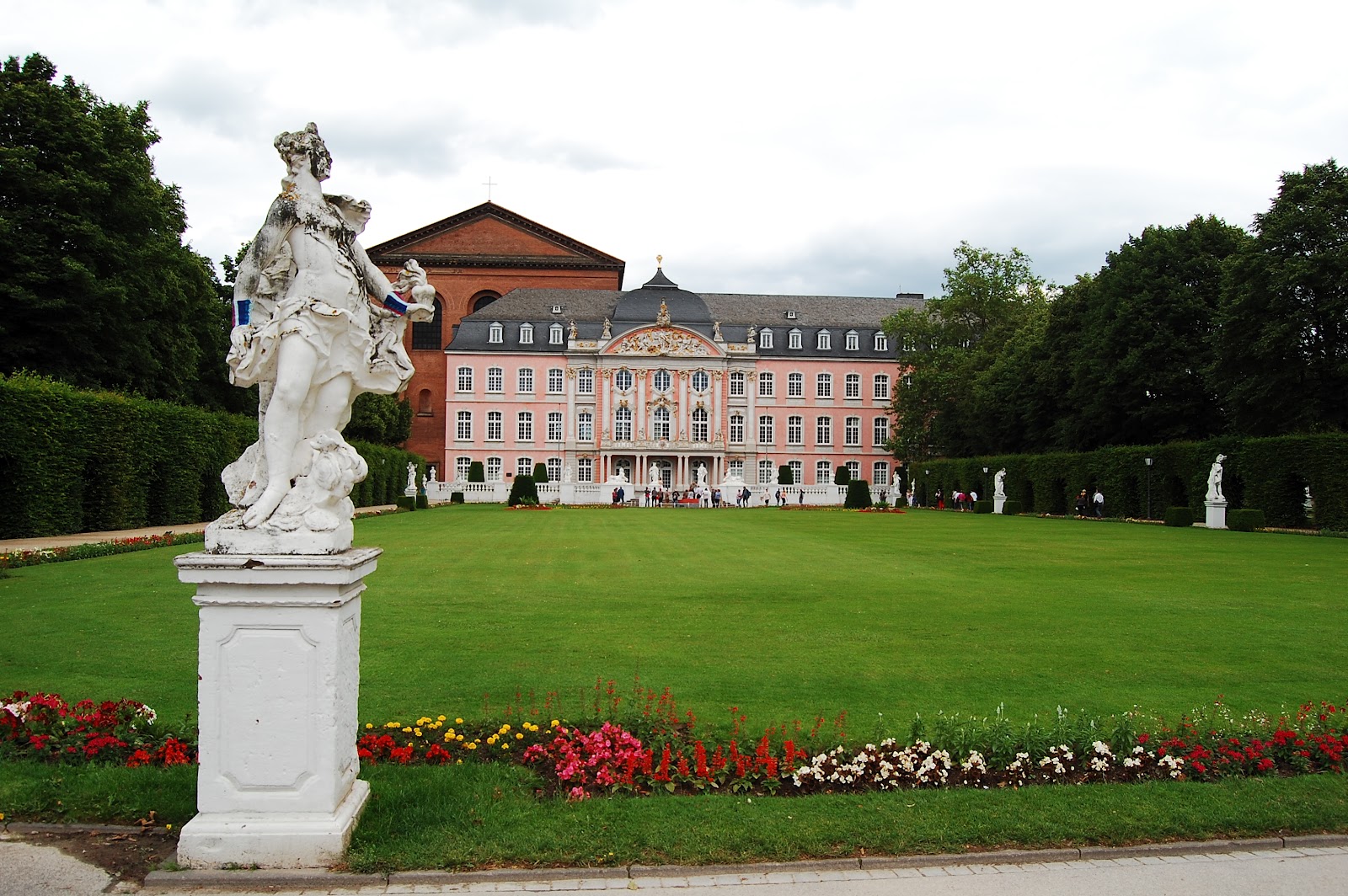
Ornate Electoral Palace

Trier from above - view from Porta Nigra. 

Public Transportation

THE OTHER DAY I was sitting on the commuter train minding my own business when a 20-something male plopped down on a chair directly across from me.  He placed his bookbag on the seat next to him.  He unzipped it and pulled out two giant plastic rubber gloves, like the kind you might see a cleaning lady wear. He carefully stretched them over both hands...and then, extremely slowly and deliberately, he used his right gloved hand to gently lift open the trash receptacle below the window next to our seat.  His approach was so cautious that it was almost as if he expected a horrifying creature to jump out at him.  He lifted the lid only a centimeter or so - wincing sideways as he did, and then suddenly, as if satisfied it did not contain said creature, flipped it close, took of his gloves, and then promptly got comfortable and went to sleep. 

Public transportation has its idiosyncrasies.  That's actually a part of the commuter train experience I look forward to - the Train Culture.  And as I look back, it seems like our children have had plenty of opportunities to experience that too.  I was looking through our photos not too long ago and was surprised to see how much we've experienced.  


Waiting for a regional train in France. 

A day's worth of subway tickets in Paris. 

Camden checks out the sign and the board (not pictured) at an U-bahn (Subway) stop in Berlin. 

A Subway zooms buy....I am honestly not entirely sure where, I think also Berlin. 

Waiting for an Italian regional train to take us to Ostia Antica in southern Italy. 

First in line for a Vaparetto - a Venician water taxi - in a late evening tour of Venice.  

A glass-covered Water Taxi in Berlin on the Spree river.  It was so hot inside of that glass Tylenol pill....

Zooming along the causeway from Padua to Venice on an Italian regional train.  

The expansive Nation subway station in Paris.  

City XPress, and ironic name for a gondola ride to the top of a mountain in Austria. 

A toy explodes in a powdery white mess on an otherwise pristine Roman subway.  

On a Deutsche Bahn short hop train to Deidesheim for the Christmas Market. 

Funicular!  Don't remember where, but it is fun to say Funicular! 

Horse and Carriage in the birthplace of Mozart - Salzburg

Frankfurt Flughafen, watching the 767 load up and waiting to board.  
Taking the ferry across the IJ in Amsterdam. 

Waiting for the metro in Amsterdam's Central Station. 
Riding a cog train to the Mer de Glace in France
A large nearly vertical gondola in Chamonix, France


On the Ferry across the channel

The famous red double-decker busses of London (see the telephone booth?)

On "The Tube" in London, arguably the worlds most well known subway. 


Aboard the Renfe Spanish regional train

On the Barcelona metro. 

This is really just a sampling of the times when I had my camera handy.  It doesn't include the French TGV, or the Deutsche Bahn ICE trains, or the gritty public buses in Rome, or the time we were jammed into a French regional train and Jazzy screamed for mommy (who was crammed into a distant corner) for 20 minutes straight, or the time a bus broke down in Rome and we got kicked off and stranded, or the time I had to have Melissa and the kids come pick me up at a small town train station an hour away from our house because the track was suddenly and mysteriously closed.

Public transportation has its idiosyncrasies.

Confessions of a drug mule

I DON'T LIKE TO BE CRITICAL of anything in Germany, because in general we like it here.   Besides,  no one or no country is faultless - including our home country - and there's really no need to point out if there's things that don't agree with us.   But in the case when we see differences,  I figure there's no harm in pointing them our for the sake of cultural reflection.

AMONG THE DIFFERENCES, one can take medical care as an for example.  In general,  Germany has an excellent medical system. They were among the first nations to consider the idea that all people should have access to affordable medical care, and the first to implement universal health care, <begin political satire> championed by that radical no-good left-leaning liberal socialist Democrat Otto von Bismarck in the late 1800s. Time will tell if this 130 year old experiment is really economically sustainable. </ end political satire>.

If there is a  difference in the US versus German medical system it lies not in the politics, but in the medical culture. We've found, in general, that the German medical system is much slower to intervene than the US. Sometimes that's  probably the best thing, but to a bunch of Americans who are used to an over-aggressive and probably over-prescribing medical system, it can be a little frustrating.  

For example, when we moved here a year and a half ago our daughter had been on a certain prescription for quite some time - which had been an tremendous help to her.   When we tried to get our new doctor here in Germany to reissue the same prescription, we got a litany of rationalization and delays.  "I'm not comfortable with that treatment." "That prescription is not approved here."  "You can't get that outside of the US." "That's too strong of a dose."    "Maybe she should just go to a psychologist." "Maybe she just needs better parenting."  (oooh, that one got Momma mad).  When I finally called the doctor to tell him we either need his help - importing the medication or working through the local US hospital, etc -  or we need to find a doctor who will, he responded with "Oh...OK, I didn't realize you felt that way.  I will have my lab mix up the medication tomorrow." Super, that would be excelle....wait, what?


I don't blame that doctor, it's just a difference in medical culture.  I think the German medical system rightly focuses more on prevention, which makes perfect sense to me during the 360 days a year that I am not sick. But on the other five?  Oh, don't get me started.

 Pharmacies (rather, Apotheke), are located on every street corner, but I am not sure I understand why. Over the counter medications either are expensive or difficult to find.  Its difficult to get Childrens cold remedies, or cold medicines in general. I'm still not sure I have ever seen DayQuil or NyQuil.  I definitely have not ever found Pepto Bismol. Not much luck with Ibuprofen or Zycam.

And getting a prescription? Not likely. Not until you have exhausted all other medical remedies, which include such things as  drinking hot tea, eating a lot of fruit, not eating meat,  keeping warm (because everyone knows cold air makes you sick),  taking an alternative hot / cold shower (because everyone knows a cold shower helps make you not sick),  and going to the sauna.   If you're desperate there are plenty of herbal remedies available, most of which seem to me to inexplicably come in the form of a nasal spray.

And antibiotics? Forget about it.  You and I both know that everytime an antiobiotic is issued bacteria gets more and more resistive to it.   US doctors and PAs seem to sort of shrug that off as a cost of medical care, but in Germany it calls to mind that line from the little girl in It's a Wonderful Life (paraphrased), "Every time a prescription for Penicillin is issued an Angel dies."   Antibiotics are  roughly as common of a medical intervention as a kidney transplant.

So this week in the US, after putting up with a nagging head-cold for about a month, I walked into a convenient care clinic in the US, announced I had a self-diagnosed sinus infection,  and walked out 5 minutes later with a prescription for antibiotics that made the pharmacist remark of the dosage,  "OK, don't take this without food because that's pretty strong. I mean really, don't take it without food."   What a country!

And here's the confession part (medical types, you can stop reading now).  I have about 20 of these little beauties in an orange bottle....I plan on taking at most 10 of them, and the rest are coming back with me to Germany where they will get stored away in our medical cabinet with gobs of other US imports that were at one time tucked in various shipment or pockets in our luggage - ibuprofen, children's tylenol, Zycam, Pepto Bismol, sore throat spray, decongenstant, and all manner of cold remedies.

There those little white pills will stay until the next time I can't kick a cold and get a medical recommendation to try wearing a scarf and have a nice hot glass of lemon tea.  But next time, that's going to work wonders...because I'm planning to have that tea with a strong dose of Amoxicillin  and a small dose of guilt.

And after that guilt wears off,  I bet I'm going to start feeling alot better.


The Opening of the Christmas Markets

THERE'S NO HARD transition into Christmas season here like there is in the States.  The end of Thanksgiving, black Friday, Cyber Monday, all signal that Christmas season has started...and started abruptly. 

But here without that national holiday it just....sort of...shifts.    The first sign Christmas is sneaking up is the low-key opening of the Christmas markets.  Before the season is over we'll visit four or five of the local markets in various towns and cities.  Each outdoor market - opening about a month prior to Christmas -  will offer warm food, hot mulled wine or cider, seasonal stands for Christmas shopping and free Christmas cheer. 

 Our town's Christmas market opened this week, so a few of us trekked down and had our first glasses of warm punch and mulled wine with the smells of winter treats sizzling from the stands nearby.  

Which, by the way, is not a bad way to get into the Christmas spirit. Not a bad way at all.